Self check-in hotel: running rooms without a reception desk
Alon Shkuri · 19 Oct 2026 · 6 MIN READ
Can a hotel really run without a reception desk, and what does a self check-in hotel need so that guests do not feel left alone at the door? The answer depends less on the lock than on everything around it: a key that arrives at the right moment, a fallback for guests who cannot use it, a way to answer questions during the stay, and rooms that suit the guests this model tends to attract.
Jordi De kort has run his properties this way from the start. He went from snack bar owner to founder of five hotels around The Hague and a new resort on Curaçao, none of them with a reception desk.
Why a self check-in hotel can be a strength, not a compromise
Self check-in is often treated as a way to save on staff, and it is. In De kort's experience it can also make a property more resilient. He never planned to run a hotel. A restaurant he liked, hit hard by the corona crisis, came up for sale with a handful of rooms above it. The plan was to turn those rooms into apartments, but neighbours objected in large numbers, and because the building already had a hospitality and lodging permit, the authorities wanted it to keep that function.
So the rooms became a hotel. They had been built like homes and furnished simply. Listed on Airbnb for 65 euro a night, they filled straight away, and prices rose through the season to around 120 euro during the corona period, while other hotels and restaurants were shut. The reason, in his words, was that the place was self-service from the start: guests got the code to a key box and checked themselves in without any staff involved.
How mobile key check-in works day to day
A key box is the simplest version. Today his doors have smart locks, and the process runs on a fixed schedule:
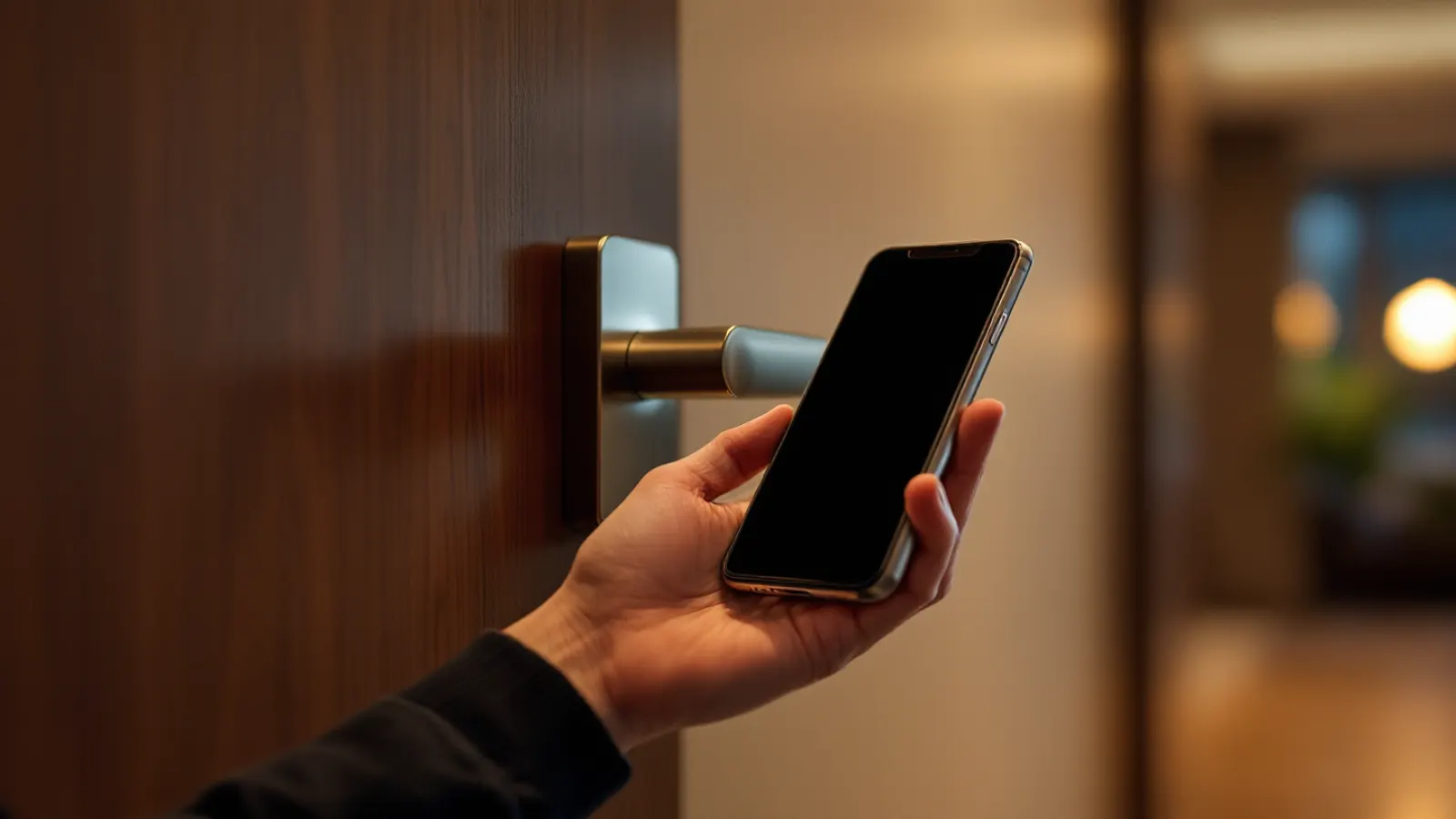
- About an hour before check-in, guests receive a WhatsApp message with a link to their digital key.
- The key only works from the check-in time, so a guest due at three cannot get in before then.
- Guests open the door by swiping the key on their phone.
- At check-out, at eleven, the key simply expires.
Many operators assume guests will miss a personal welcome. De kort assumed so too. He told his team to walk around at check-in times, help with suitcases and greet people in person. That did not land the way he expected.
“Mensen vinden het juist prettig om anoniem te zijn en in te checken. Dat doen ze thuis ook.”
Jordi De kort, 18:59
(Translated: “People actually like being anonymous when they check in. That is what they do at home too.”)
The biggest benefit, he says, is that you need no front desk staff, which saves a lot. The trade-off is a less personal approach to the guest, and he openly wonders whether that is a disadvantage at all. Hotels that choose the opposite path invest in a hotel concierge service instead.
A fallback for guests without a smartphone
Keyless entry does not suit every guest, so the system needs a plan B. In De kort's experience, older travellers sometimes have no internet or no smartphone, and he sees the same hesitation among some German guests. His solution is low tech. Physical key cards hang in a lockbox with a code on the facade. The manager watches the cameras, and when someone is clearly stuck at the door, they are told which box to open and what the code is. The guest keeps the card during the stay and drops it in the letterbox on the way out.
The same goes for questions during the stay. They used to go to an emergency phone on the door, which he says gave no guest experience at all. Now every booking confirmation links to a guest web app laid out in tiles with the most common questions, such as directions and how things in the room work. By his account close to every guest uses it. Tools like this are where artificial intelligence in hotels can take over routine questions.
Rooms built for longer stays
Without a desk, the room has to do more of the work. In De kort's hotels each room has the facilities of a home: a washing machine, dishwasher, sitting area, a fully equipped kitchen and where possible a separate bedroom. That attracted people who come to work in the region for a while, people going through a divorce and people looking for a house, with tourists filling the gaps in high season. He points to the many international companies and schools in The Hague as a source of that demand.
“Je speelt eigenlijk op 2 markten in en ik denk inderdaad richt een hotelkamer zo in zodat mensen zich ook voor langere tijd thuis kunnen voelen.”
Jordi De kort, 16:04
(Translated: “You are really playing two markets, and I think you should furnish a hotel room so that people can feel at home there for a longer time too.”)
The economics back this up. He estimates a changeover, with linen, cleaning supplies and the cleaning itself, at perhaps 60 euro, which makes one-night stays hardly worth it. His aim is to push the average stay towards a week, and some guests already stay three or four months.
Quality matters too. Once his interiors went high end, reviews went up straight away, and higher reviews mean more bookings. It is one practical way to improve guest satisfaction without adding staff.
What to build into a self check-in hotel before you open
Most of the decisions that make this model work are made before opening. Asked what he would do differently, De kort does not hesitate: furnish every property to a high standard from day one, with the same materials everywhere, instead of improving a little with each new hotel. When choosing a building he looks at:
- parking;
- the chance to create outdoor space;
- how easy the location is to reach;
- whether the floor plan allows the rooms he wants. His smallest location has eight rooms, at around 50 square metres each.
Two investments, in his experience, always pay back. The first is an energy A-label combined with solar panels. His properties are going off gas entirely and heat with air conditioning units powered by the panels.
“Je kan een betere financiering ophalen. Sommige banken die eisen naar A-Label en dan krijg je wat rente korting.”
Jordi De kort, 10:30
(Translated: “You can raise better financing. Some banks require an A-label and then you get a bit of an interest discount.”)
The second is the software for digital check-in. He calls it a substantial investment that has to be prepared during construction, not added later.
If you are weighing this model for your own property, the story of how one forced conversion grew into a small group is worth hearing in his own words. You can watch the full conversation.
Frequently asked questions
What is a self check-in hotel?
A self check-in hotel lets guests arrive and enter their room without a reception desk. In the hotels Jordi De kort describes, guests receive a WhatsApp message about an hour before check-in with a digital key that opens the smart lock on their door at the agreed time. The key expires automatically at check-out, so no staff need to hand anything over.
Do guests miss the personal welcome at reception?
Less than you might expect, according to Jordi De kort. He first wanted staff walking around at check-in times to help with luggage and welcome people, but found that guests prefer to arrive anonymously, the way they come home. He does accept that the approach is less personal, and he questions whether that is really a downside.
How do you handle guests without a smartphone?
Older guests sometimes have no smartphone or internet, and some German guests also prefer a physical key. For them his hotels keep physical key cards in a coded lockbox on the facade. A manager watching the cameras sees when someone is stuck, gives them the code, and the guest drops the card in the letterbox when leaving.
What should you prepare in the building for keyless entry?
Jordi De kort calls the software for digital check-in a substantial investment and says it has to be planned into the construction from the start. He would also furnish every property to the same high standard from day one, and invest in an energy A-label and solar panels, which in his experience always pay back.